Converging & Diverging

Production Line

There is a pattern Converging and Diverging in Architectural Lens described as:

Can you channel people so they come together (or split up)?

Example:

Gates (and gatehouses) channel visitors through a narrow opening, allowing a toll to be levied, or to help control potential threats.

Every manager should use this architectural solution in everyday life. This design trick helps to optimize the work flows. Grouping and ungrouping save the most valuable asset – your time.

For example, if hiring three new people this month do your best to have the same start date for all three. Thus, you are able to save time on introductory trainings, adaptation lectures and other activities. You are doing it once for all of them and not three times for each one.

The same technique I would recommend to use with emails. Every manager is overloaded with them. Save your time by building the rules that group emails into folders. Based on sender, receiver, topic, project, distribution list or whatever. Don’t proceed them immediately. Read you inbox once per hour or even less frequent. As soon as your messages are grouped you can work on specific work streams and not on a single email. You have no switch of context. Thus, you are acting more effectively. And you have the picture of the work stream in a one place.

Splitting the single work stream works brilliantly in many cases as well. E.g. it is useful to split one meeting into two in case if agenda has two separate work streams. Even if the list of attendees stays the same. It helps to concentrate, prepare and focus on a single topic. It makes the meeting far more effective.

The same technique is applicable to email writing. You can split an email into two different threads if there are several topics discussed at the same time. And you can merge a plenty of emails back into single follow-up message to outline the list of actions outstanding and focus on an implementation and not discussion.

Disclaimer: be careful when grouping people. It might be perceived unfair. Even if it is not. One consider himself as a unique person. And that is absolute true. Always care about people and their feelings. The same problem when team is jelled and it is pain for them to be splitted. Take care of people. Always.

Inspired by: http://www.danlockton.com/dwi/Converging_%26_diverging

Peer Feedback

Peer Feedback

Today I’d like to choose a pattern Peer Feedback  from Interaction Lens described as:

Can you give users feedback on their behaviour from other users of the system, equal in status to themselves?

Example:

Peer feedback on comments and stories is central to sites such as Slashdot (‘karma’ scores) and Digg (’digging’ and ‘burying’).

Surprisingly, when thinking about the mapping of this pattern to the managerial world it was not a 360-degree-performance-review that came to my mind first. Moreover, I think this not about performance review at all.

That’s all about your team being transparent. That’s about culture of sharing and giving feedback. If everybody are sharing status, problems, ideas and targets among peers they can get valuable feedback. Thus it is possible to understand how it looks from different perspectives. And finally, get proposals from peers on how to work together to get the synergy.

Don’t hide the information. Don’t work independently with each team member. And don’t let them work separately. That’s management style from the past. Shift to social approach. The team that shares and communicates is twice better than a group of people who don’t.

Surprisingly, it is not about tooling that helps. It is more about culture. Focus on the team transparency. Start from yourself. Don’t hide anything. Give the feedback and get it back. The team will do the same.

This trend is everywhere around us. CNN reports that some tech companies are thinking about switching from e-mail to more social oriented platforms. Yammer (Facebook for business) does a great job and growing. Sergey Polonsky made reality show from his business and publishes all meetings to the internet for discussion.

You shouldn’t afraid that more knowledge inside the team will bring more politics. It will definitely change the politics landscape but it will not increase it for sure. When everything is transparent and discussed there is no background for it. Politic’s main horsepower is in information that not available to others. Less hidden information less horsepower to politics.

Disclaimer: Do not forget that internal transparency is not equal to external transparency. Identify the areas that are business secrets and make sure that no one shares it to external world. External transparency might be not good for business. However, who knows …

Inspired by: http://www.danlockton.com/dwi/Peer_feedback

Feedback Through Form

Feedback Form

There is a pattern Feedback Through Form in Interaction Lens described as:

Can you use the form of your object itself as a kind of interface, giving feedback or suggestive cues?

Example:

Royal VKB’s 100g/250g Balancing Bowls are weighted so they tilt noticeably and audibly when the ‘portion size’ is reached when filling

That is all about shaping. Template is the best and the most clear example of this approach. If you ask for a Weekly Status Report than you should define a format. Give the list of topics to cover. In this case the problem of status report is shaped and both parties get a predictable result. This approach simplifies the communication a lot.

The same happens if you are publishing RFP. Unless you shape the structure of the response there is no chance to get all information you need and compare proposals you receive.

Looks easy. However, most of the managers forget about giving the structure to their expectations. As the result they receive feedback that doesn’t match the expectations. The same applies if you are preparing a major report or document for someone. Confirm table of contents before moving forward. Think about it. Make the communications easier.

Disclaimer: Templates kills creativity. However, I see nothing bad in breaking the rules. The problem is in not following rules. Thus, in case if you know and understand a rule and have a strong rational reason to break it – just do it. Otherwise, read the rules first.

Inspired by: http://www.danlockton.com/dwi/Feedback_through_form

Portions

A year has passed since my earlier post on the topic of similarity between design and management approaches. Fortunately, I feel that this thread should be finished and will continue with more posts on the topic.

Boutiques use portions of goods adjusted to what their typical customers are comfortable with.The next pattern to discuss is Portions. This is a design pattern from Errorproofing lens:

Can you change the size of the portions or the units of ‘stuff’ you give users?

Example:

‘Portion packs’ for snacks give customers the ‘right’ amount of food to eat in one go (sometimes a particular amount of calories).

That is exactly how you should communicate with people. Each person has a capacity. Some can accept a lot of information at once others don’t. Thus, your communication style should consider this capacity and split the information to the messages of a proper size and structure.

You should consider how busy the person is and his reading style. It useless to write a lot to a busy person. He sees that the content is too big and either skips it or put on hold till someday when he has time. That day will never happen for sure.

The number of topics per message should be adopted to the person as well. The best option is to have only one topic per message. However, it varies based on a number of messages per day a person can work with. Some people are more comfortable to have one complicated message rather a dozen of quick three-sentence-notes.

Disclaimer: there are no rules of thumb. Just think about lifestyle of the recipient and adjust your message to make it comfortable for him. That’s it!

Inspired by: http://www.danlockton.com/dwi/Portions

Roadblock

There is a pattern Roadblock in Architectural Lens described as:

Can you put things in users’ way, so they take an alternative route, or adjust their speed?

Example:

‘Chicanes’ can slow down drivers, pedestrians and cyclists; the crossing chicane prevents running or cycling straight across the road.

The same behavior you need from people sometimes. There are stages of the process that people are trying pass trough without paying a special attention. While they are crucial for success. That’s where roadblocks should exist.

For example: decision-making process. A manager gets a task. Finds the first possible solution and starts implementing it. However, you what him to move slowly. His goal not to find a solution but get the best possible one.

You have to put a roadblock here. Just force him prior starting the implementation to create a document. He should describe in one page the solution itself and at least two alternative solutions considered. That will force him to slow down while making a decision and think about an options and rationale. That is exactly what you need.

Disclaimer: there are cases when speed is crucial. The roadblock should be easier to pass then but still exists.

Inspired by: http://www.danlockton.com/dwi/Roadblock

Challenges and Targets


Challenges and Targets
are sweet words in the management. In design world this pattern is described as:

What happens if you set people a challenge, or give them a target to reach through what they’re doing?

Example:

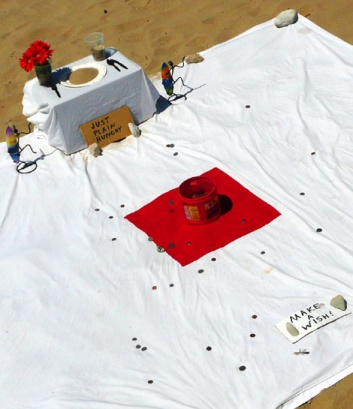
Whoever laid out this coffee tub as a target for throwing coins knew a lot about influencing people to donate generously and enjoy it.

Being the key words in any book on management challenges and targets are usually missed in our everyday job. Our days are filled with routine. Most of people are not aware that this routine is aimed to the specific target. Each problem or mistake is perceived negatively as an obstacle while in reality it is positive challenge.

Managers should care about the way they see the job, the routine, the environment. It should be full of targets and challenges to face. Each achievement is making you stronger, better and moves you forward. Just try to feel it.

However, this post is about patterns. Challenges and Targets shows you the way how to run projects and set tasks to your employees. You should not just ask to do something but set specific targets and outline challenges to face. That will make the work itself more interesting and clear.

There are two key benefits here. First one is that you are not managing but doing a leadership that shifts you to another level. And the second one is that you focus people on result while they are usually focused on process. Together this way of setting tasks makes one personally interested in succeeding in it and sets the right priority of achieving the target.

Disclaimer: boring stuff is the part of our life. You cannot convert everything to a challenge.

Inspired by: http://www.danlockton.com/dwi/Challenges_&_targets

Partial Completion

Partial Completion is the pattern for today. In design world it is described as:

Can you show that the first stage of a process has been completed already, to give users confidence to do the next?

Example:

Pre-filled details such as delivery addresses can be an effective way of speeding up an order process and reducing ‘shopping cart abandonment’

In managerial world this pattern is very useful when you have to pass through natural resistance of people when doing something new. By nature humans afraid of leaving comfort zone. And when they have to pass that barrier they don’t know how to start and what to do.

Partial completion is the way to pass it. You provide a guidance and feeling that this is not a full size greenfield work. Partially completed work is psychologically accepted as a clear and easy to do. It might be just a template with several sentences but it helps.

As an example think about a case when you are mentoring interns. You have passed all necessary initial education and adaptation. It is the right time to give them a real world task. However, usually they are stalled with it. Even if they are 100% ready to implement it.

In case if they have to prepare a report, business plan or another document just give them a template with some sentences in it. When they are back with questions tell them that they shouldn’t care about the whole task and should populate it section by section. That will give them feeling that you control the flow and share responsibility. Surprisingly, they’ll do it quick and easy.

Disclaimer: Be sure that people are ready for the work. If they are not — partial completion doesn’t work. Another possible issue is that pre-filled information is accepted as 100% true while it might be not.

Inspired by: http://www.danlockton.com/dwi/Partial_completion

Fake Affordances

Let’s talk today about Fake Affordances pattern described as:

Is there anything to be gained from making something look like it works one way, while actually doing something else (or nothing at all)?

Example:

Many elevator/lift ‘door close’ buttons are reputedly ‘placebo buttons’, giving an illusion of control but not speeding up the process.

This is the best ever defined management-under-stress technique. When the project has a high visibility, tough delivery schedule or high risks there is an extreme attention from stakeholders. Thus, you have to manage not only the internal delivery itself but external control over it. The same problem exists when delay or non-crucial fail happens. All stakeholders are trying say what to do and how to fix.

Frankly speaking, in most cases you know the reasons and actions required yourself. Each suggestion slows you down. Each external influence affects the team. Thus, feel free to accept any suggestions and promise corrective actions just to give feeling of control to your stakeholders. This will save you time and keep your team focused.

You can use it with boss of your boss as well. Sometimes it happens when a top manager is trying to micromanage. He might be wrong due to lack of information. However, due to his power you cannot say “No” or “Maybe”. He expects immediate action. Thus, give a fake promise if needed. He’ll get what he wants: a feeling of control. And you’ll avoid acting the wrong way. At least immediately.

Disclaimer: there are two issues with this pattern. First, you might me be wrong. Second, you might be considered as a liar. Both are disaster to you. Take care.

Inspired by: http://www.danlockton.com/dwi/Fake_affordances

Angles

The next pattern I’d like to talk about goes from Architectural Lens. It’s name Angles and described as:

Can you slant or angle things so some actions are easier than others?

Example:

Some cigarette bins are sold to authorities using the sloping top as a feature, discouraging people leaving litter on top.

This pattern has great use in management. Policies, roles, organizational chart, titles, departments and so on makes the corporate environment rectangular. Everything has a definition and purpose. Unfortunately, it decreases the flexibility.

There are cases when rules set in the rectangular world don’t let you to achieve your goal and do a specific action. Think about changing the angle. It might help.

Let me give an example. You have a new project. You clearly understand that you are the right person to start it. However, if you become a project manager during the kick off your chances to step back are low. Customer will not accept this move. You have a dilemma: whether to let the project start slowly without you, or you do fast kick off and have to take part in it for a long time due to rectangular rules.

The solution is to call yourself an engagement manager and do your job. Don’t care if this title doesn’t exist in your company.

It is nice practice to change your title, organization chart position, role in the project or department name to ‘hack’ the system. This is exactly changing the angle solution. You are forming the layout that makes some actions difficult to make. E.g. if renaming project manager to engagement manager you make it difficult for the customer to keep you on the project for a long time.

Every time you face obstacles due to rectangular policies, job definitions or reporting dependencies think about changing the angle that creates new surface and makes your life easier.

Disclaimer: you should know that most of the people don’t like non 90 degrees things 😉

Inspired by: http://www.danlockton.com/dwi/Angles

Hiding Things

The pattern for today is Hiding things. Original description says:

Can you hide functions or elements you’d prefer people didn’t use?

And example is:

These church hall heating controls have been hidden (leaving only the timer accessible) to reduce errors by users unfamiliar with them

In managerial world this pattern has two major applications. Positive and negative as you guess. Being the good guy by nature I’d like to start with the positive one.

Hiding things is the good approach for writing documents, policies and so on. 80% of long document is a kind of over-complication. The core message usually takes less than two or three paragraphs and is useful for the most readers. Ten more pages are about minor details and facts behind the proposal. Just split your writing into two parts. A short message to fulfill  the needs of most of your users and a number of pages to provide background and details for some of them. Save the time to your readers.

I’m always looking for the executive summary section. In most cases it works perfectly well. All other chapters can be just scanned that saves time.

Unfortunately, the most positive pattern that makes usability happen in the real world becomes the dirty trick in the communication. This pattern is the brilliant way to put something in writing that not welcomed by the recipient. Just let me show several examples.

The first one is about corporate policies. Have you ever read them? The bigger company is the more complicated they are. As the result it is perfect place to hide something. E.g. your company has a policy that allows ordering pizza or taxi on a specific occasion. However, to use them you should find the right regulatory document. Surprisingly, there is no pizza or taxi ordering policy. It is part of a 60-page-long office space regulatory policy. Those who are aware are using the service. Others are suffering from the pattern. Whether it was done on purpose or not is the question to you. Bad author does it accidentally. The good one does it on purpose!

Another usage of this pattern is emailing. There are cases when you need to put disclaimer, notification or fact into the message to cover your back. However, the counterpart wouldn’t ever confirm this information. So, it is your turn to do the dirty Hiding Things pattern. Write the long message with two or three messages in it. Put you tiny message (that is expected to be skipped by the reader) right after the tough and intriguing question near the end of the message and cross your fingers. In 50% cases if not used daily it works.

Disclaimer: whatever reason you have to hide something you should think from the reader’s perspective. The most awful thing is when writer of the document can’t understand the reader properly. Hiding Things is the most dangerous pattern in this case.

PS: If you don’t you like politics and avoid even thinking about dirty tricks you are not ready for anything more intriguing and interesting but a line management.

Inspired by: http://www.danlockton.com/dwi/Hiding_things